In December 2009 I decided I was going to run a Marathon and 12+ months later I did it. Now I’m training for my second marathon which is rocketing toward me on November 5th. I’m not worried about this one. I’ve been training (did a 16.5 mile run today!), still have plenty of time and there’s a vacation (Hawaii!!) to be had at the end of this month which will surely refresh me as I’m taking that week off and starting in on my last 8 weeks of training when I return.
The marathon decision isn’t to be taken lightly though. It takes a lot of time out of your life to run all those miles, trust me! And it means you already have plans on every weekend for the next 16-20 weeks…running and recovery. It also means that you’ll need to go to bed before American Idol goes off the air for the night. And there’s also a nutritional component that many forget about. Meals need to be thought out a bit more especially pre-run meals and then there’s what you’ll eat/drink for energy while on those long runs because from mile 6 to 26.2 plain water just won’t do it for you anymore. Basically, it’s a huge life changing decision that you’ll need to make with the help of the people in your life since the decision will effect them too. Know what you’re signing up for…it’s not just one morning a few months from now.
I must say that after training for my first marathon I’ve been more cognizant of my time commitments. Even more so now that I’ve decided to go for another marathon of sorts. Tomorrow, (Monday) I officially start my PhD program in Adult Education. I’ve been taking a few classes toward that goal as a non-degree seeking student for the past couple years, but now the real academic “training” begins! This academic ultra marathon will take several years!
Of course there are only so many hours in a day. So I’ve decided to limit myself to running half-marathons or shorter distances starting next year and moving forward while I work on my PhD. I’m excited about this decision! This means that I can focus on primarily one specific distance and improving my time for the 13.1 miles. I’m thinking I can not only break the 2-hour mark, but also cut another 10-15 minutes off my time after that!
Have fun training for all your marathons both the physical and mental kind!
I’ve been training non-stop since December 2009 for some running event or another…there have been one or two… Across these last 20 months I’ve improved my fitness level from running nearly a 3 hour half-marathon to a ~2 hour half-marathon and ran my first full-marathon eight months ago. All great accomplishments. My whole focus besides proving I could do it was to just “get in shape” and lose some weight with an emphasis on weight loss early on. I quit weighing myself as often a few weeks ago and checked in again yesterday afternoon with my friend “The Scales”.
I’ve realized that sometimes you have to just “Keep at It” regardless of what the scales say because your body is going to adapt the way it needs to not necessarily the way you want it to in the end. You may care about the beach, but your body doesn’t. I had been weighing in consistently for several months at around 180lbs up until yesterday…
On Thursday I weighed 174lbs! I’m getting so close to my goal weight of 160-165 that I can’t wait, but honestly at this point I’m more interested in my fitness level, body fat percentage and the way I feel more than the actual number on the tell tale scale.
I was beginning to wonder if I’d lost some more because my interval runs and tempo runs had been getting easier for the program I’m on at present (FIRST Program). I kept being able to push it a bit more than what was prescribed. Then my trainer saw me Thursday morning and asked if I’d lost some more weight. I actually said, “No”. That I was just looking different because of the weight lifting I’d been implementing twice a week…I’m happy to admit that I was wrong! Never been so happy to be wrong!
So the message of the week is to keep at it even if the scale isn’t moving for several months. You have to send your body enough messages telling it that you’d like a change. Mine has quite a learning curve and seems to be using two tin cans and a string for communication so the message is slower…. 🙂
So take a look at your exercise routine, diet, calorie consumption and calorie expenditure. Are you sending consistent messages or mixed messages? Just something to ponder.
My next run, a full marathon, is 92 days away. I’m looking forward to running it at 174 pounds or less!
So last weekend’s long run went great! I started off on the local Monon Trail which is a segment of Indiana’s “Rails to Trails” program. It wasn’t too long of a “long run”, but it was the first lengthy jaunt since my last last half-marathon on June 11th. I set out on my 10-miler and the weather was perfection! I had my music, my hydration pack, and I was keeping a much faster pace than my training program stipulated. I was supposed to be running an 11:03 pace and at the end of mile 1 I looked at my Reebok sport watch to see that a mere 8:45 had passed….oops! So I slowed down and continued on down the trail. At mile 2 I looked at my watch again to find that I had successfully slowed down…by 15 seconds. I was still a full two minutes ahead of the pace.
Novice runners may think, “Great! If you can run faster then you should!” Alas, with 8 more miles to go maintaining a pace that’s 52 seconds faster than my best half-marathon pace isn’t the way to train smarter. I also know that 10-miles is the shortest weekend run I’ll be doing until November when I taper for the Indianapolis Monumental Marathon. Experts say that for every second you gain in the first half of a race by running faster than your “trained for” pace that you’ll lose 2 seconds on the back end of the race. I’ve found this to be very true. I wish it hadn’t of taken me 18 months to figure it out though….I have had a tendency to go out too fast and sputter half way thru in the past. Not until this past May did I run my first race with some margin of intelligence and stuck to my pacing plan for a full 13.1 miles. The result? A 2:05:56…my best half to date.
After mile two I made myself slow down a lot more, but still maintained a ~10:20 pace across the 10 miles. When I got home I decided that a GPS device may be in order and I decided on the Garmin 305. My fiancee, Kate, had mentioned she might get me one for my birthday or Christmas, but after a quick talk with her we decided that since I have the Indianapolis Monumental Marathon in November and Goofy’s Race and a Half Challenge in January that I should go ahead and order the Garmin 305 now so I can train with it the rest of the year. The Garmin will help me maintain a better (smarter) pace and let me be more accurate on mileage since the Monon Trail curves a bit. I ended up running 10.34 miles. No big deal, but when I get up to 15-25 miles on a long run in a few weeks that extra distance will add up a lot more and make a big difference!
The Garmin arrived on Monday and it had a heart rate monitor with it. I’m excited to try it out this weekend and see how my heart rate responds to running as compared to last year. I know my resting heart rate is around 60-62 bpm. This will also give me a better indication of how many calories I burn on a long run. I’ve been estimating a 100-110 per mile, but I want to see what the Garmin indicates based on heart rate.
This coming weekend is a 12-miler. I’ve become focused on dropping another 10-20 pounds before January 7th and the Goofy Challenge. I’d like to be between 160-170 pounds by then. I’d also like to be at least 8-10 pounds lighter by the end of August…we’re going to Hawaii! Hey! Not every goal is about the next race. Sometimes it’s about the beach! 🙂
A lot of times when we hit the gym we go for the “more bang for your buck” workouts. Multi-muscle, multi-joint exercises are always being touted as a “Time Saver”, “Calorie Burner” or “Only way to go if you have X amount of time”…. I would have to agree.
Using more than one muscle group DOES burn more calories. This technique also saves you time as opposed to working each single muscle group individually. However, occasionally it’s a good idea to hit those tiny little muscles we forget about when we’re hitting those Lats, Pecs and Quads getting ready to look buff for the beach or just in our normal training for our next race. I found out as much when I had an hour long session with my personal trainer last week. I bought a training sessions package from my gym back in December 2009 and I’ve been able to make the sessions last for 18 months since I don’t do a PT session the week of any race or over holidays….there’ve been a couple holidays and a lot of races in the past 18 months! 🙂
So I’ve been training for 18 months and my trainer “handed me my hat” so to speak on these small muscle exercises over the course of the hour. I was sweating bullets on the first couple exercises that worked the front of the lower leg. These three little guys are in charge of pulling the toes back toward your shin (dorsiflexion), rolling your foot inward (inversion), rolling your foot back out (eversion) and extending your big toe (extending your big toe…). So these muscles are fairly important to running, swimming, biking, walking, standing, and to a lesser extent bouncing on a pogo stick (actually not sure on the last one because I can’t do that, but I’m glad you’ve decided to come with me on this one).
Exercise Physiology 101 Terminology...enjoy.
So here I was laying on the floor with a cable strapped to my foot with my foot at a 90 degree angle to my lower leg and pulling my knee toward my head. Basically a knee-up in the supine position (flat on your back). By the third set (3×15) I was barely able to keep my foot from pointing down and letting the cable slip off. It was a LOT of work! This would be a great exercise for shin splints too as it strengthens those muscles.
Next we worked on the inner/outer thigh machines which I’ll say that not a lot of guys in my gym use. But when you’ve experienced ITBS like me, you don’t care anymore. These machines hit those muscles and strengthen them so you can help stave off ITBS. The muscles being worked here also support the sides of your knees. Raise your hand if you could use a healthier and more stable knee or two!!!! Ok, put your hand down now…people are beginning to stare….
Single Leg RDLs (Romanian Dead Lift)
What’s next you ask? Single leg Romanian Dead Lift with a dumbbell (not me the weight…). Want a strong ankle and superior balance? Do single leg RDLs. In the picture the guy (not me BTW) has his leg bent slightly. This is okay, but an RDL technically has a straight leg. Note that he has a straight/flat back as well. We did a super set on these with a seated row since the big muscle being used IS your back. This also works your core! Triple bonus!
WARNING: If you’ve never done RDLs ask a trainer at your gym to model it for you. Just call it a single leg dead lift with a dumbbell…a good trainer should know what it is. Use a light weight until you get the form down.
We did all sorts of other stuff, but I’ve rambled on long enough so I’ll put the core work in another post. You shouldn’t always isolate the small muscles since you hit them when you work the big ones, but take a single workout every 2-3 weeks to concentrate on the small muscles and you can see some big gains!
It has come to my attention from one of my readers (Thanks Jenn!!) that runDisney has yet to post Jeff Galloway’s updated training program for the 2012 Goofy Challenge. Being a training program connoisseur of sorts I downloaded it back when it was still posted in 2010. Thinking back I guess I already knew that runDisney had taken the old training program down since I had emailed them about the dates being “off”. The dates were off since it hadn’t been updated since 2009 when it was originally published, but the basics were there. Now remember race fans, this program is designed to get you across both finish lines in the upright position not set land speed records at Disney World. It’s a fairly simple program that follows Jeff’s run/walk philosophy. Most weeks you only run 3 days and rest/recovery is a key component of the program.
Seeing how I don’t have express written consent by the Walt Disney Company or Jeff Galloway to republish the PDF I have (assuming I can find it…) I will talk in generalities and answer questions if you have any. Don’t worry though, there’s a table below with a week by week schedule.
You know you want it...or one very similar to it!
Keep in mind that my goal for the 2012 Goofy Challenge is to cross both finish lines on Saturday and Sunday in the upright position and live to tell the tale! I have a friend who’s running it with me and we are both determined to finish and earn a lot of bling…that’s it! OH! Before I forget…I’m also doing the 5K on Friday which will be a nice warm-up and an extra medal! 🙂
The program is around 30 weeks in length. I’m sure once runDisney updates it the numbers may not be exactly the same. For my own use, I adapted the program a little to fit my own needs, but the basis of the plan is here. Also, I believe it is suggested that you have been running for 6 months prior to starting this Goofy Training Program. If not, take it easy and follow the plan as prescribed by runDisney.
As always, you should consult a licensed medical professional (aka: a doctor/physician) before beginning any exercise program. Especially, if like me you are a middle aged guy with a Peter Pan-esque view on life! Hopefully, I spelled out the fact that you are at risk in this 39.3 mile undertaking and that you’re making the decision on your own to do this training program or participate in it in any way either in full or in part…..heck people, GOOFY is the mascot! There’s a little bit of crazy going on to try something like this and I’m doing the 5K too so that makes me just plain Dopey!
Okay, enough of the legal speak about it being YOUR decision and YOUR own liability should something bad happen to you. You have been warned!! On to the training program!
Like I said, this program is fairly simple. I’m not going to get into the whole run/walk method because that is Jeff Galloway’s thing. There is also a training tool Jeff suggests called a “Magic Mile” which he has you do every so often to see how you’re progressing. I’m a runner and plan to run 85-90% of both races not including the time it takes to stop for pictures. Oh yes, there will be lots of pictures! Again, see my blog post about the WDW full-marathon last January 2011.
So here it is…in general…the 30-ish week Goofy Challenge Training Program as best as I can remember it. By the way, if you actually followed this program then you would start in mid-June. The program takes you a couple weeks PAST the WDW full-marathon on Sunday January 8th, 2012 for recovery purposes.
Tuesdays and Thursdays are 30-45 minute run/walks according to the original program. Go to Jeff Galloway’s Website for details on the run/walk method. You’ll notice that you get six weeks of training before you have your first weekend of back-to-back workouts. I also took the liberty of switching the run days for Christmas and New Year’s Day to Saturday, but feel free to run when you want! Oh, and don’t forget to plan for holidays (in no particular order) like July 4th, Thanksgiving, Hanukkah, Labor Day, Father’s Day, President’s Day, Ramadan, Boxing Day, Administrative Assistant’s Day, Yom Kippur, My Birthday (Oct. 7th), etc.
Week
Mon
Tues
Wed
Thur
Fri
Sat
Sun
1
Rest
30-45 min
Rest
30-45 min
Rest
Rest
Run 3 mile
2
Rest
30-45 min
Rest
30-45 min
Rest
Rest
Run 4 mile
3
Rest
30-45 min
Rest
30-45 min
Rest
Rest
Run 5 mile
4
Rest
30-45 min
Rest
30-45 min
Rest
Rest
Run 3 mile
5
Rest
30-45 min
Rest
30-45 min
Rest
Rest
Run 5 mile
6
Rest
30-45 min
Rest
30-45 min
Rest
Walk 3 mile
Run 7 mile
7
Rest
30-45 min
Rest
30-45 min
Rest
Rest
Run 6 mile
8
Rest
30-45 min
Rest
30-45 min
Rest
Rest
Run 8 mile
9
Rest
30-45 min
Rest
30-45 min
Rest
Rest
Run 6 mile
10
Rest
30-45 min
Rest
30-45 min
Rest
5 mile
Run 10 mile
11
Rest
30-45 min
Rest
30-45 min
Rest
Rest
Run 11 mile
12
Rest
30-45 min
Rest
30-45 min
Rest
Rest
Run 12 mile
13
Rest
30-45 min
Rest
30-45 min
Rest
Rest
Run 8 mile
14
Rest
30-45 min
Rest
30-45 min
Rest
Walk 5.5 mile
Run 14 mile
15
Rest
30-45 min
Rest
30-45 min
Rest
Rest
Run 11 mile
16
Rest
30-45 min
Rest
30-45 min
Rest
Rest
Run 15.5 mile
17
Rest
30-45 min
Rest
30-45 min
Rest
Rest
Run 9 mile
18
Rest
30-45 min
Rest
30-45 min
Rest
Walk 7 mile
Run 17 mile
19
Rest
30-45 min
Rest
30-45 min
Rest
Rest
Run 12 mile
20
Rest
30-45 min
Rest
30-45 min
Rest
Rest
Run 18 mile
21
Rest
30-45 min
Rest
30-45 min
Rest
Rest
Run 10 mile
22
Rest
30-45 min
Rest
30-45 min
Rest
Walk 9 mile
Run 20 mile
23
Rest
30-45 min
Rest
30-45 min
Rest
Rest
Run 13 mile
24
Rest
30-45 min
Rest
30-45 min
Rest
Rest
Run 21 mile
25
Rest
30-45 min
Rest
30-45 min
Rest
Rest
Run 11 mile
26
Rest
30-45 min
Rest
30-45 min
Rest
Walk 12 mile
Run 23 mile
27
Rest
30-45 min
Rest
30-45 min
Rest
Rest
Run 7 mile
28
Rest
30-45 min
Rest
30-45 min
Rest
Run 6 mile
Xmas
29
Rest
30-45 min
Rest
30-45 min
Rest
Run 7 mile
New Year’s Day
30
Rest
30 min
Rest
30 min
Rest
WDW Half
WDW Full
31
Rest
30 min
Rest
30 min
Rest
Rest
Run 7 mile
32
Rest
30 min
Rest
30 min
Rest
Rest
Run 6 mile
Of course, you may opt to throw in some cross training for some of those rest days. I would suggest taking a rest day before and after those weekends where you’re doing a long walk followed by a long run the next day. Your body (muscles, ligaments, joints, etc) need the rest even if you’re not tired.
You may also want to do specific types of runs for the “30-45 min” runs on Tuesday and Thursday. I do intervals and Tempo runs on those days…usually a little longer than 30-45 minutes. I also add in a little lifting on some days usually twice a week with my cross training.
HOWEVER, the above program should get you across the finish line both days with no adaptations or additions needed. I bet you’ll even be smiling at the end of day two! I know I will! 😀
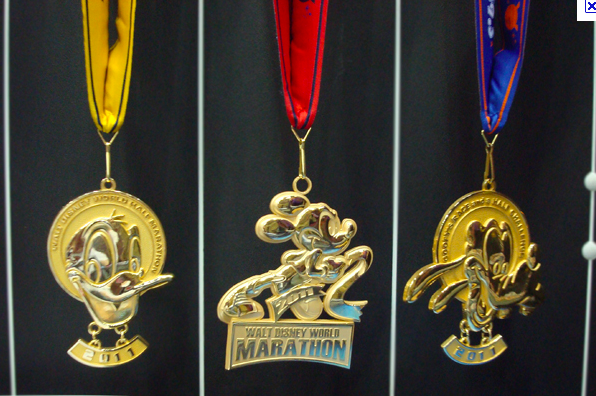
All that stands between you and these three medals (besides common sense) is the proper training program!
Let me know if you have any questions and happy training!
I get bored easily with training programs. It’s a curse. Perhaps I watched too many action flicks as a kid where the hero was shown doing all the cool “training to fight” scenes or maybe I just like variety on the run, but I change training plans after every major training initiative it seems. I’m always trying to find a better way! I was a devout Hal Higdon follower when I started this whole weight loss/running phenomena and then I converted to the wise musings of Saint Galloway toward the end of last year. I’ve even dabbled in the teachings of the Wizard Yasso. I guess I take the approach that if I can take a little bit from each program and add in some common sense then I’ll eventually come up with a kick-butt training program to last me for a while.
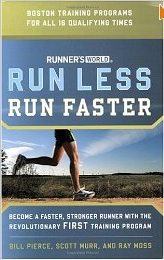
So here I go! I’m in the process of reading the book Run Less Run Faster which covers the FIRST (Furman Institute of Running and Scientific Training) Program. Oddly enough, I found that after reading a bit of the book that I had inadvertently adapted my current training program to be almost like the FIRST Program. I had everything except the intensity at which the program trains for its three weekly runs.
The program focuses on quality workouts rather than a quantity of runs 5-7 days a week as many runners (including me) have done for training in the past. So I thought I’d give it a try since the creators of the program have years of research supporting how well the training works along with a plethora or runners heaping accolades on how they’ve cut 20-30 minutes off their marathon times. Testimonials are great, but they don’t hold water for me unless I see hard data to back up the claims. The FIRST Program has both.
The program works around a “3plus2” philosophy. That’s three runs a week and two cross training workouts a week. For the three runs they have specific goals in mind and really ramp up the intensity. This week so far I’ve completed two of the cross training workouts (also intense) and Key Training Run #1. I won’t go into too much detail as you should really go buy the book (see picture) if you’re interested. Plus, you’ll need the pacing charts in the book to really get anything out of the program’s weekly plan.
That being said, I’ve been training weekly 5-6 days a week to train for multiple half-marathons and other races over the past 18 months so I feel I’m pretty well “fit”. After three days on this program I’m happy to say that my butt is dragging! Due to the intensity of the runs and cross training I’ll say that I realize why there are only three quality runs a week. Before I was just putting in the mileage apparently. Now, I feel like I’m putting in quality miles and really need the rest/recovery before my next run! It’s awesome!
Best of all is with three runs a week (plus the occasional Goofy Challenge weekend double workout!) I can look forward to less worry as my schedule gets hectic this coming fall when I’m still working full-time, finishing up wedding plans, traveling, taking 6 credits toward my PhD and still finding time to enjoy family and friends. Heck, I might even be able to sleep at some point! 🙂
And here’s a bonus for all of you who are chasing a BQ time. This program is designed to get you there regardless of age. The book has a couple chapters devoted to that end.
I’ll blog further updates on my FIRST experience as I train this year. If you want to follow my training more closely then feel free to join me on the Daily Mile.
The greatest spectacle in racing! The Indy 500 was dubbed thus so many years ago and this year Indy is in the midst of celebrating it’s 100th year of memories spanning from 1911 to present day.
The Indy Mini-Marathon started in 1977, bringing in Olympic champion distance runners Frank Shorter and Bill Rogers. In 1979, the Mini-Marathon became an official 500 Festival event. The event grew rapidly in the 1980s and even more throughout the 1990s. Today, the OneAmerica 500 Festival Mini-Marathon is noted as the nation’s largest half-marathon with a field of 35,000 runners and walkers participating each year. The course is flat, fast and allows participants to run the 2.5 mile Indianapolis Motor Speedway!
But enough with the history lesson! This past Saturday May 7th was perfect for running in Indianapolis. The morning brought temperatures in the mid-50s and the winds were quiet.
Last year (2010) I ran “The Mini” in 02:33:25 and was very happy with my time as I had been training for 5 months and had just started my fitness journey and lost about 20 pounds. My time was 22 minutes faster than my 2009 time. This year I ran the 13.1 mile race in 02:05:49 approximately 18 minutes faster (and another 35 pounds lighter) than my 2010 race.
Besides having an extra 12 months of training I tried a few more things this time around to improve my performance this year. First was knowledge (or information would perhaps be better way to describe it.) I’ve been having trouble keeping a consistent pace recently. Basically, I go out too fast which is a common error for new runners. You feel good, you run fast and then you crash hard on the second half of the course.
Pace Tat
This year I wanted to run a more consistent pace throughout the race so I strapped on a temporary pace tat so I could keep tabs on my pace throughout the run. This is also a lot cheaper than a GPS watch (though I’ll be adding that to my Xmas list this year too)! These are very good if you are wondering. I could still use the tat for a run three days after the race. It has survived a half-marathon which ended with rain and several showers!
Next, leading up to the Indy Mini-Marathon I was reading a book called “Racing Weight” by Matt Fitzgerald and in the book the author mentions how performance is effected by various factors like hydration and muscle glycogen.
Of course everyone realizes that being hydrated is a good thing. Don’t drink enough water during a long run and eventually you’ll slow down or stop altogether as your body has trouble cooling itself and your blood gets thicker from having less water in it.
Next, most of us know that we need fuel (carbs) during a long run like a half marathon. We take sports drinks with us and consume gels like GU along the race course.
What I didn’t know was that exercise induced muscle damage causes fatigue separately from hydration or fuel availability. So I looked into using a product that would help this third performance limitation. I found a product called Accelerade from Pacific Health Labs which has a combination of carbs and protein to help limit muscle damage from prolonged exercise like a marathon or half-marathon. The company also makes a gel called Accel. So I bought some Accelerade and instead of taking GU on my 13.1 mile fun run I added some Accel gel to my run pack.
Now I will say that from training for a year I was in much better shape and I did run a much smarter race with my pace tat, but still I liked the Accel gel and I did feel like I had a lot more energy during the mini-marathon. The consistency of the Accel gel wasn’t as thick as a GU gel so it was a lot easier to take and I didn’t feel like I needed to wait until I was near a water station to have something to drink with the gel like I do when I use GU. I still like GU, but I’ll be using Accel a lot more in the future.
Another thing I can say is that the day after the mini-marathon my legs felt great and I never experienced the pain that shows up two days after such an intense exertion. When I ran the Kansas half-marathon four weeks ago (in 02:11:37) my legs were tired the next day and I did experience the major stiffness that usually comes 48 hours after (called DOMS). So the Accelerade (taken pre & post race) along with the Accel gels seemed to help me recover faster than with just GU and a whey protein shake per my usual routine.
So my experience at The Indianapolis Mini-Marathon was great! I even made it onto the local news on WTHR. I had a half dozen of my friends tell me that they saw me on the news running around the Indy 500 Motor Speedway.
Now I have 5 weeks to continue training for my next race (another half-marathon). I’m excited to continue using Accelerade while I train and to use the Accel gels for my next half. My recovery workouts this past week have been very good and I’m ready to jump back into training on Monday!
I’ve written about tapering in the past, but felt it was worth writing about again as I approach my next half-marathon this coming Saturday. I’m running the nation’s largest half-marathon, The Indianapolis Mini-Marathon with 35K+ other runners in Indianapolis, IN.
35,000 runners participate in the Indy Mini-Marathon. The course takes runners around the Indy 500 Speedway track!
What prompted this post was all the “taper tweets” I’ve been reading this morning. Many runners are worried about doing too much or not enough in the last 7-10 days leading up to their race. I totally understand dear friends!
First off for all my new runners out there you might be asking, “Tapering? What’s that?” Tapering is the final days leading up to your big event when you workout less so as to get the recovery you need for race day. Whether it’s a 5K, 10K, 15K, Half, Full or Ultra marathon it really doesn’t matter. All of these have a little taper time before hand.
In my opinion and experience, how much tapering you need depends a lot on your amount of current running experience, the distance you’re going in your event and the number of races you’ve run prior. All of this combined should fit into a plan of what works best for you.
For me, I tend to taper for 7-10 days before anything less than a full-marathon. So two weeks out from this half I did a final 10 mile long run. Last Friday I did a 6 miler and primarily rested over the weekend except to do yard work. This week I rested Monday and I’ll do short runs Tuesday and Wednesday. I lifted last week on two days and did a very light (high rep) full body weights routine today (Tuesday). I’ll be finished with any weight lifting after today. Thursday I will go to the gym and do something non-impact like cycling, elliptical or maybe just walking on the treadmill while I watch ESPN. 🙂 Friday I will take off completely (and sleep in past my usual 4:30am wake-up call) since the race is the next day.
One big component of my tapering is stretching. I normally stretch after every workout, but I will take a little extra time to stretch my IT Bands, glutes, legs, shoulders and back. Basically, instead of doing 2-3 sets of stretches I will do 3-5 sets adding 10-15 minutes of extra stretching. Many times I’ll also use my foam roller at night to make sure I have all the knots worked out of my legs.
As for diet, I don’t change much in the taper zone. 2-3 days out from the race I do eat a little more pasta….mainly because I really LOVE pasta! There is a lot of hype around carb loading, but I’ve read the actual research studies and while stored muscle glycogen (sugar/carbs) is a limiting factor for performance (sorry about the geek speak), the average runner doesn’t get a lot of benefit from carb loading. As long as you rest a couple days before an event, your muscle glycogen stores will increase just from not exercising. You’ll also want to replenish during the event/race with Gatorade, gels, etc. at regular intervals. Basically find what works for you and stick with it.
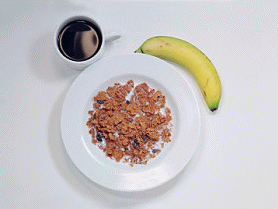
Actual breakfast not shown....wrong cereal.
For me, I eat a measured serving of cereal, a banana and a cup of coffee a couple hours before the race. 15-30 minutes out from the start I pop a GU Energy Gel and then continue to take more gels as the race progresses usually every 30-45 minutes. I also use the provided water and Gatorade on the course. I might be overloading on the carbs, but it doesn’t bother my stomach so I stick with the plan. I also don’t have to worry about hitting the wall at mile 11 and crawling to the finish line.
Remember, tapering is a good thing! You won’t lose the ability to run long distance in a week…or even two weeks. I’ve even had races where I didn’t workout at all 5-6 days before an event and did fine during the race….including earning a PR by over 8 minutes! I chalk it up to being well rested.
Tapering is also a time to make sure you are getting extra sleep. If you are a morning exerciser, sleep in those last two days before an event and get your 8 hours (or more if possible). If you are an evening exerciser use the gym time to get a few things done early so you can get to bed early. Don’t waste the time on the TV…that’s why we have DVR! 🙂
Active.com had a decent article on Tapering today as well if you’d like to check it out! Also, Runner’s World had a good article on Recovery days today. Though not specific to tapering it speaks well to recovery which is what tapering is all about!
I travelled out to Olathe (O-LAY-tha), KS (Home of Garmin by the way) to visit friends and run a half-marathon this past weekend. First off, I had a great time visiting and being back in Kansas. It’s just a nice area where I used to work and it was good to hangout with friends for the entire weekend.
Now, it is a popular misconception that Kansas is as flat as a pancake. I am here to tell you that this may very well be the case in several locations around that state, but that is not the case if you are visiting or running a half-marathon in Lawrence, KS. Lawrence, KS is home to The Jayhawks (KU). If you are an NCAA basketball fan you may have heard of them…just not this year. 🙂
Up until now the half-marathons and one full-marathon I’ve ran have all been relatively flat. I train weekly with a slight incline on the treadmill, but it looks like I need to add some hardcore hill training to the mix. So I went out and found a good program for hill training that I can do once every 7-14 days.
Indoor (Treadmill) Hill Training: From Runner’s World
Warm up for 10 minutes, then set the treadmill at your approximate marathon pace. (If you’ve never run a marathon, estimate your marathon time by multiplying your typical 10-K time by 4.65.) With the treadmill elevated 1 degree, run for 2 minutes at marathon pace, then elevate the incline to 2 degrees and run for 2 minutes. Next return to 1 degree for 2 minutes, but then climb to 3 degrees for 2 minutes.
Continue in this manner, raising the grade on every other 2-minute repeat until you’ve reached 7 degrees (the inclination pattern is 1-2-1-3-1-4-1-5-1-6-1-7). If you feel exhausted before you reach 7 degrees, stop, and don’t let it worry you. Try the workout several more times and you’ll develop the ability to handle the hills. Finish the workout by running an easy 8- to 10-minute cooldown.
This should help me take on those hills better. I really think I could have ran a 02:10:00 half or better had I been conditioned for hills. There was a hill in the middle of the course that seemed to go on (and up) forever. The race started and ended on several smaller hills and there was only two areas of the course that were over a mile without a significant incline.
Now I’m really looking forward to the Indianapolis Mini-Marathon which is almost completely flat. Good chance I’ll PR again and come closer to that sub 2-hour half I’m chasing!
The 15K…one step down from the half-marathon. Not so long as to fear not finishing but longer than a short weekend run. The 15K (9.3 miles) is a nice distance and I had the opportunity to run my first 15K this past Saturday as a part of the Indy Mini-Marathon Training Series sponsored by OrthoIndy. I had a fantastic time starting out at the NCAA Hall of Champions Saturday morning at 8:00am! Over 1600 runners and walkers showed up to run under slightly cloudy skies and warm weather. I was one who had ambitions of beating the rain…..alas no one runs faster than Mother Nature if she decides the grass needs watering! I got a little wet on the way back to the car, but I ran the half mile from the finish line to my automobile. The rain felt good!
It was a great day for a run! Lower 60s temps met the running group as we ran on much of the same route that we’ll run on in May for the Indianapolis Mini-Marathon. My official time for the 15K was 01:28:06. This being my first 15K I was guaranteed a PR for the day!
One thing I reinforced in myself at the start was my commitment to pace myself better. At the beginning of the race I was telling myself, “go out slow, go out slow, go out slow…..” Last time for the 10K I had ran the first two miles at an 08:45 pace which was way too fast for me….closer to my 5K pace and I paid for it in the last half of the race. Alas, even though I was telling myself to slow down I approached the 1-mile marker with a time of 08:30:00. Makes me wonder what the time would have been if I had pushed it! I slowed by 15 seconds on the next mile and then tried to maintain closer to a 9 min/mile pace for the remainder.
I did slow down toward the end which is inevitable when you go out too fast due to lactic acid build-up in your legs. Elite runners and running coaches agree that for every second gained in the first half of a race by running faster than an optimal pace you will lose 2 seconds in the second half. Better to run an even pace throughout the race or slightly faster on the back half. My overall pace for the 15K was an average of 09:28/mile. Pacing is something I will continue to work on in my upcoming three half-marathons next weekend, May 7th & June 11th.





 Running Down a Dream 23's Blog